
1/11

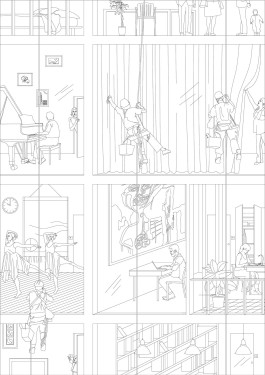
A Second Shot: Architecture often fails to respond to human crises. Produced during the pandemic in homage to capriccios and Aldo Rossi’s L’Architettura Assassinata, this drawing takes aim at that inertia. At its epicentre is a tabletop: a window upon which our chaotic lives unfold. The city beyond is rendered as flattened memory and canvas, as we prepare to emerge having received our second shot of vaccine.

Exhibited: Venice Biennale
2/11
Dressing Down Parliament: The political establishment no longer represents its people. Dressing Down Parliament is a drawing of the Palace of Westminster stripped of its veneer of gothic ornament to reveal the crumbling structural brickwork behind. It seeks to pave the way for more inclusive and diverse forms of representation in the wake of Brexit.


Exhibited: Lisbon Triennale
3/11
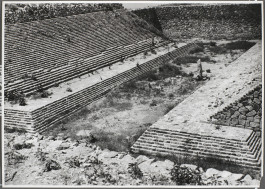
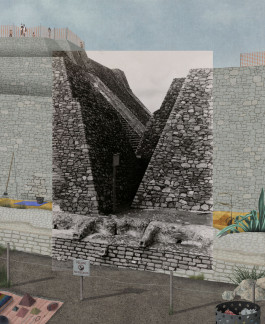
Sideways: Mass tourism often frames the historic places we conserve and cherish. While modernists like the Albers concentrated their reductive gaze on abstracted forms and patterns, Sideways looks toward the messy reality of these monuments. By extending the margin of their photographs, the drawing explores the friction between the romance of ancient sites and the surrounding ‘ugliness’ that both sustains and threatens them.


Collaboration: OMMX with Forms of Living
4/11
Cue: People find themselves squeezed into ever-smaller boxes. This installation playfully overlays aspiration and reality by superimposing the furniture associated with grand country hallways. It is neither a chair, side table, drawer, coat stand, grandfather clock, plant pot, nor mirror, yet it is all at once. Its form is familiar, its function ambiguous. It merely provides cues for its use and misuse.


5/11
Restoration: UNESCO World Heritage status paradoxically protects and burdens, inviting tourism while preventing the growth needed to accommodate it. Our extension to the Begijnhof Brugge subverts this tension by exploiting the language of temporary works. An oval timber structure forms a cloister within a cloister. It is a scaffold for repairs that houses the crowds the historic site struggles to contain.


6/11
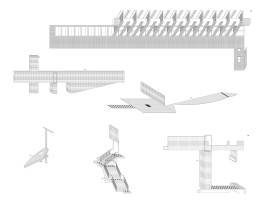
Reliquary: Where do buildings go when they die? Cities exist in a perpetual state of fragmentation and erasure. By repositioning demolished material into a supra-structure within an old quarry, we create a reliquary: a repository of future archaeology. This processional route holds the dead city in suspension, valuing a recent past that would otherwise be lost to landfill.




Collaboration: OMMX with James Taylor-Foster
Exhibited: Cooper Union, FRAC, Campo
7/11

L’Oignion: UNESCO status has left Graz in stasis, a victim of its own beauty. We propose to interrupt this cycle by destroying everything below a fixed datum. While the iconic skyline is preserved above, the ground is liberated as a realm of infinite possibility, fantasy and madness.


Exhibited:
Drawing Matter
8/11

The Plot Thickens: Legal plots are usually defined by reductive red lines. This project challenges that model by augmenting the boundary between private and public space. By giving the line physical thickness, we create a new semi-public realm that bleeds into the city, replacing rigid ownership with a shared intermediary landscape that individuals are encouraged to have direct agency over.

9/11


A Sense of Place: Commissioned for Tank Magazine, these drawings of Madrid serve as a stage set for the fashion house Delpozo. By depicting the specific urban corners that inspire creative director Josep Font, the project collapses the distance between imagination, drawing, and the city.


10/11

Land of Exceptional Qualities: Aesthetics is often sidestepped in planning discourse for more easily quantifiable aspects of a building. Yet, it remains vital in defining a culture. This project confronts the terms by which taste is defined, opening up the critical question of whose aesthetics are being protected, and why.

Collaboration: OMMX with James Taylor-Foster
11/11

Teaching: We teach because it matters. Focusing on how technology disrupts the status quo, we examine the orthodoxies and misconceptions that render societies impotent to enact change. An academic setting provides a collaborative, discursive and rigorous platform to look at the phenomena affecting our environment with urgency and without bias.

A Second Shot: Architecture often fails to respond to human crises. Produced during the pandemic in homage to capriccios and Aldo Rossi’s L’Architettura Assassinata, this drawing takes aim at that inertia. At its epicentre is a tabletop: a window upon which our chaotic lives unfold. The city beyond is rendered as flattened memory and canvas, as we prepare to emerge having received our second shot of vaccine.
1/11
Exhibited: Venice Biennale


Dressing Down Parliament: The political establishment no longer represents its people. Dressing Down Parliament is a drawing of the Palace of Westminster stripped of its veneer of gothic ornament to reveal the crumbling structural brickwork behind. It seeks to pave the way for more inclusive and diverse forms of representation in the wake of Brexit.
2/11
Exhibited: Lisbon Triennale

Sideways: Mass tourism often frames the historic places we conserve and cherish. While modernists like the Albers concentrated their reductive gaze on abstracted forms and patterns, Sideways looks toward the messy reality of these monuments. By extending the margin of their photographs, the drawing explores the friction between the romance of ancient sites and the surrounding ‘ugliness’ that both sustains and threatens them.
3/11
Collaboration: OMMX with Forms of Living
Cue: People find themselves squeezed into ever-smaller boxes. This installation playfully overlays aspiration and reality by superimposing the furniture associated with grand country hallways. It is neither a chair, side table, drawer, coat stand, grandfather clock, plant pot, nor mirror, yet it is all at once. Its form is familiar, its function ambiguous. It merely provides cues for its use and misuse.
4/11

Restoration: UNESCO World Heritage status paradoxically protects and burdens, inviting tourism while preventing the growth needed to accommodate it. Our extension to the Begijnhof Brugge subverts this tension by exploiting the language of temporary works. An oval timber structure forms a cloister within a cloister. It is a scaffold for repairs that houses the crowds the historic site struggles to contain.
5/11
Reliquary: Where do buildings go when they die? Cities exist in a perpetual state of fragmentation and erasure. By repositioning demolished material into a supra-structure within an old quarry, we create a reliquary: a repository of future archaeology. This processional route holds the dead city in suspension, valuing a recent past that would otherwise be lost to landfill.
6/11
Collaboration: OMMX with James Taylor-Foster
Exhibited: Cooper Union, FRAC, Campo

L’Oignion: UNESCO status has left Graz in stasis, a victim of its own beauty. We propose to interrupt this cycle by destroying everything below a fixed datum. While the iconic skyline is preserved above, the ground is liberated as a realm of infinite possibility, fantasy and madness.
7/11
Exhibited:
Drawing Matter


The Plot Thickens: Legal plots are usually defined by reductive red lines. This project challenges that model by augmenting the boundary between private and public space. By giving the line physical thickness, we create a new semi-public realm that bleeds into the city, replacing rigid ownership with a shared intermediary landscape that individuals are encouraged to have direct agency over.
8/11
A Sense of Place: Commissioned for Tank Magazine, these drawings of Madrid serve as a stage set for the fashion house Delpozo. By depicting the specific urban corners that inspire creative director Josep Font, the project collapses the distance between imagination, drawing, and the city.
9/11

Land of Exceptional Qualities: Aesthetics is often sidestepped in planning discourse for more easily quantifiable aspects of a building. Yet, it remains vital in defining a culture. This project confronts the terms by which taste is defined, opening up the critical question of whose aesthetics are being protected, and why.
10/11
Collaboration: OMMX with James Taylor-Foster
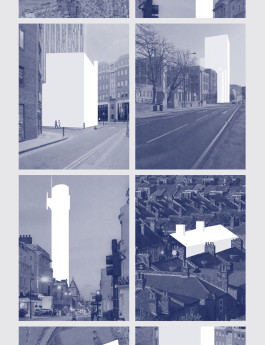
Teaching: We teach because it matters. Focusing on how technology disrupts the status quo, we examine the orthodoxies and misconceptions that render societies impotent to enact change. An academic setting provides a collaborative, discursive and rigorous platform to look at the phenomena affecting our environment with urgency and without bias.
11/11

